

GENESIS GV80 COUPE: WHAT’S AN E-SUPERCHARGER?
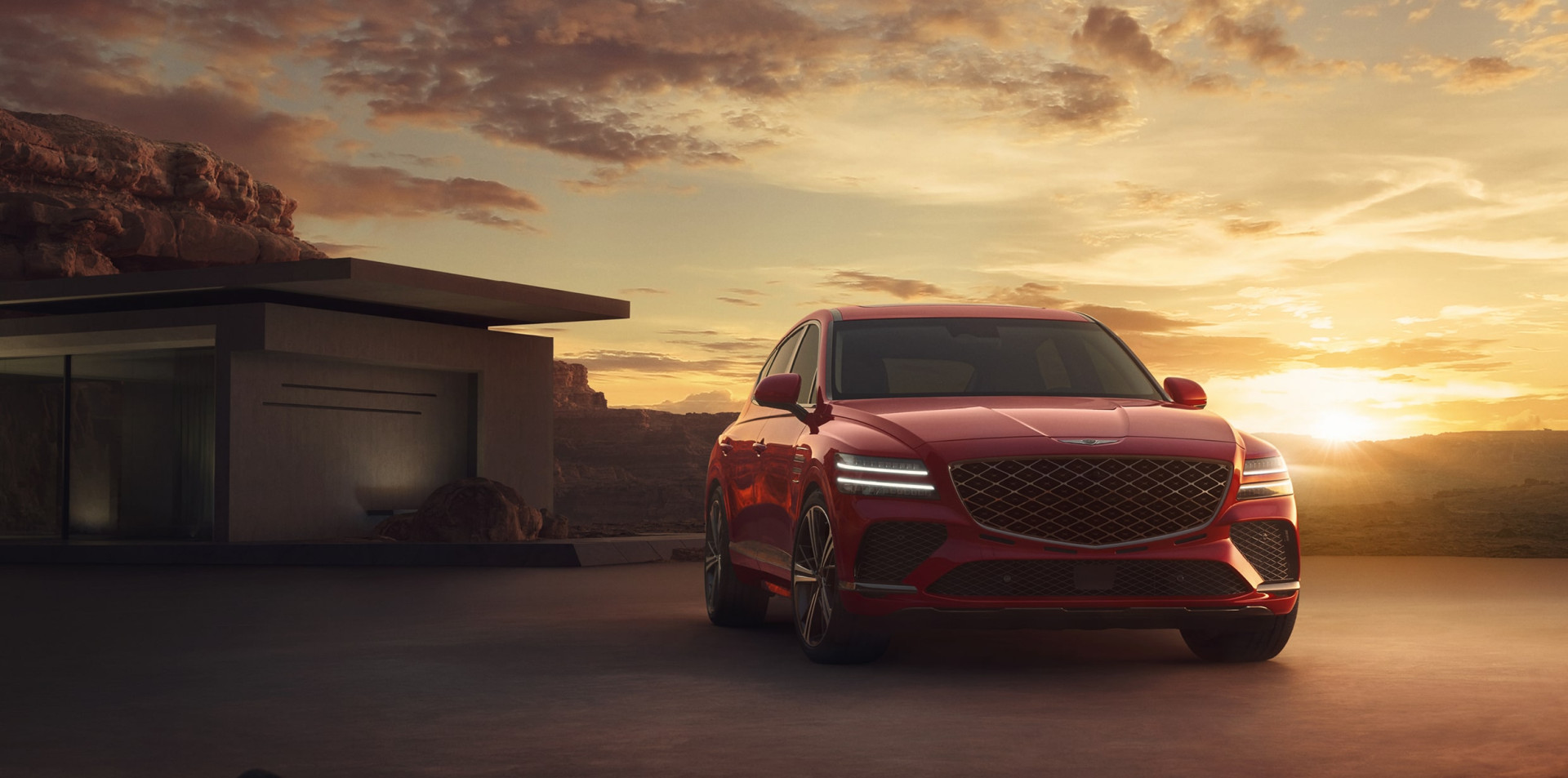
SEOUL, Sept. 26, 2024 — The Genesis GV80 Coupe embodies the perfect blend of coupe DNA with SUV prowess. With its plunging roofline and aggressive contours, the model, one of the latest to be added to the Genesis product lineup, pulses with athletic energy inside and out.
As a sportier alternative to the GV80, the GV80 Coupe offers three powertrain options, all based on gasoline: a turbocharged 2.5-liter inline-four engine that makes 304 horsepower; and a twin-turbocharged 3.5-liter V-6 that produces 380 horsepower, while the same engine coupled with a 48-volt electric supercharger (e-supercharger) spikes its output to a higher 415 horsepower.
Available only in the GV80 Coupe and Genesis’ flagship sedan G90, the e-supercharger stands out as a defining feature that simply cannot be overlooked.
How It Works
While the e-supercharger in the G90 focuses on providing smooth and comfortable rides, the one set aside for the GV80 Coupe has been specifically tuned to provide rapid response and acceleration.
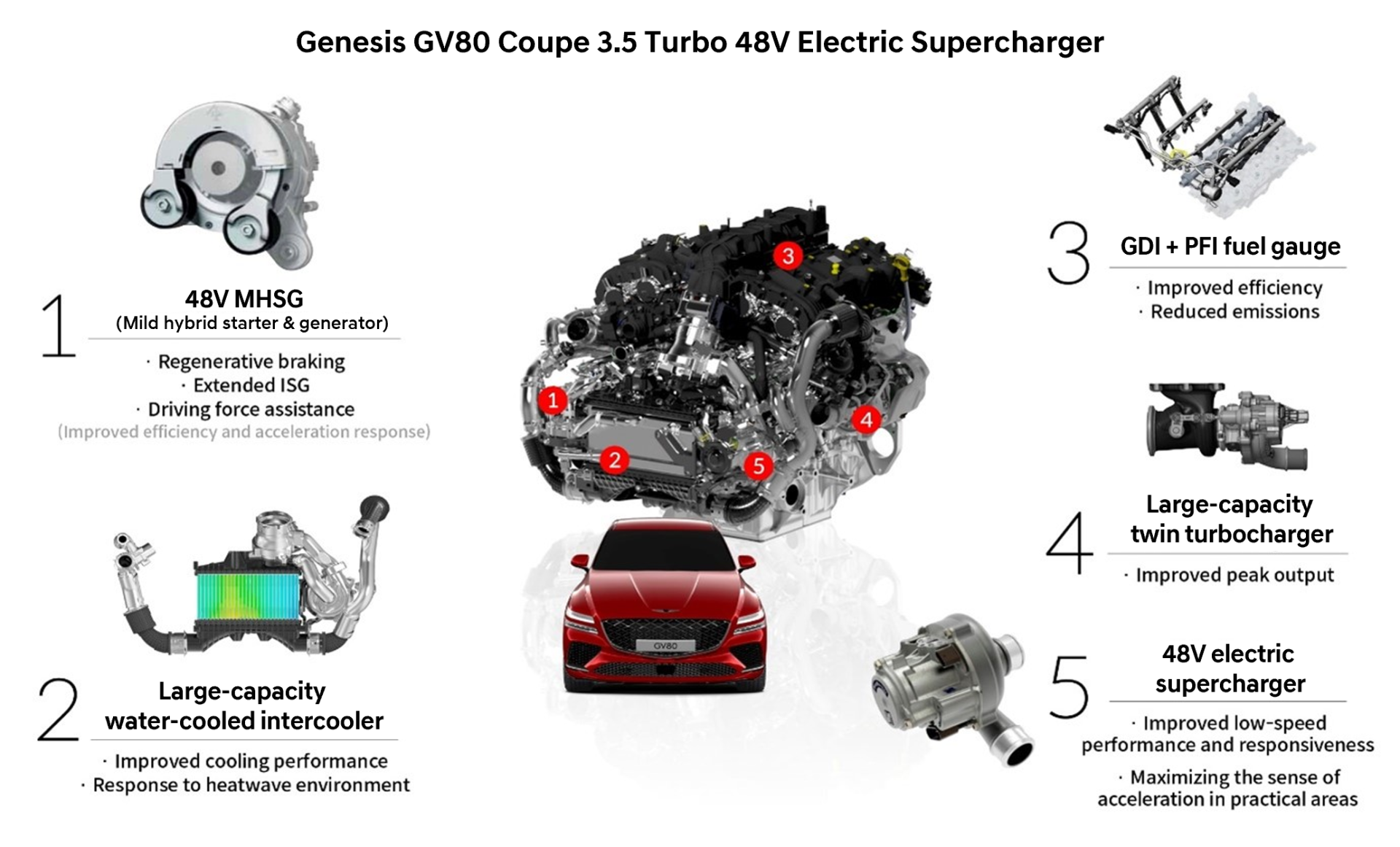
When compared with the twin-turbocharged 3.5-liter V-6 engine, the twin-turbocharged 3.5-liter V-6 engine mounted with an e-supercharger incorporates a 48-volt mild hybrid starter-generator (MHSG) along with a 48-volt e-supercharger, which together provide more power assistance, improve low-end turbo lag, enhance responsiveness and increase fuel efficiency.
To boost maximum output, the capacity of the turbochargers installed on each side of the engine with an e-supercharger has been increased, while in relation to this upgrade, the water-cooled intercooler capacity has been improved to enhance cooling performance and responsiveness.
In addition to assisting power, the 48-volt MHSG performs the role of recharging the 48-volt lithium battery during regenerative braking, all the while functioning as a generator and starter motor.
A key feature of the e-supercharger-assisted engine is that its two-stage boosting system ensures responsiveness at low engine speeds.
Typically, a turbocharger uses exhaust gas to spin the turbine following combustion in the engine, which then drives a compressor wheel to compress air into the engine, increasing output. Enhancing the turbocharger’s capacity can increase airflow and ultimately boost maximum output, but this normally leads to longer compression times. Therefore, when the engine is under load or operating at low speeds, it can cause a delay in acceleration or slower throttle response.
The 48-volt e-supercharger, however, addresses these drawbacks by activating at speeds below 1,750 revolutions per minute. It compresses air behind the compressor wheel and delivers it to the engine, increasing low-end output and reducing turbo lag. When the engine reaches higher revolutions per minute, where the turbochargers alone are adequate for boosting, the air bypasses the e-supercharger and is directly supplied to the engine intake manifold.
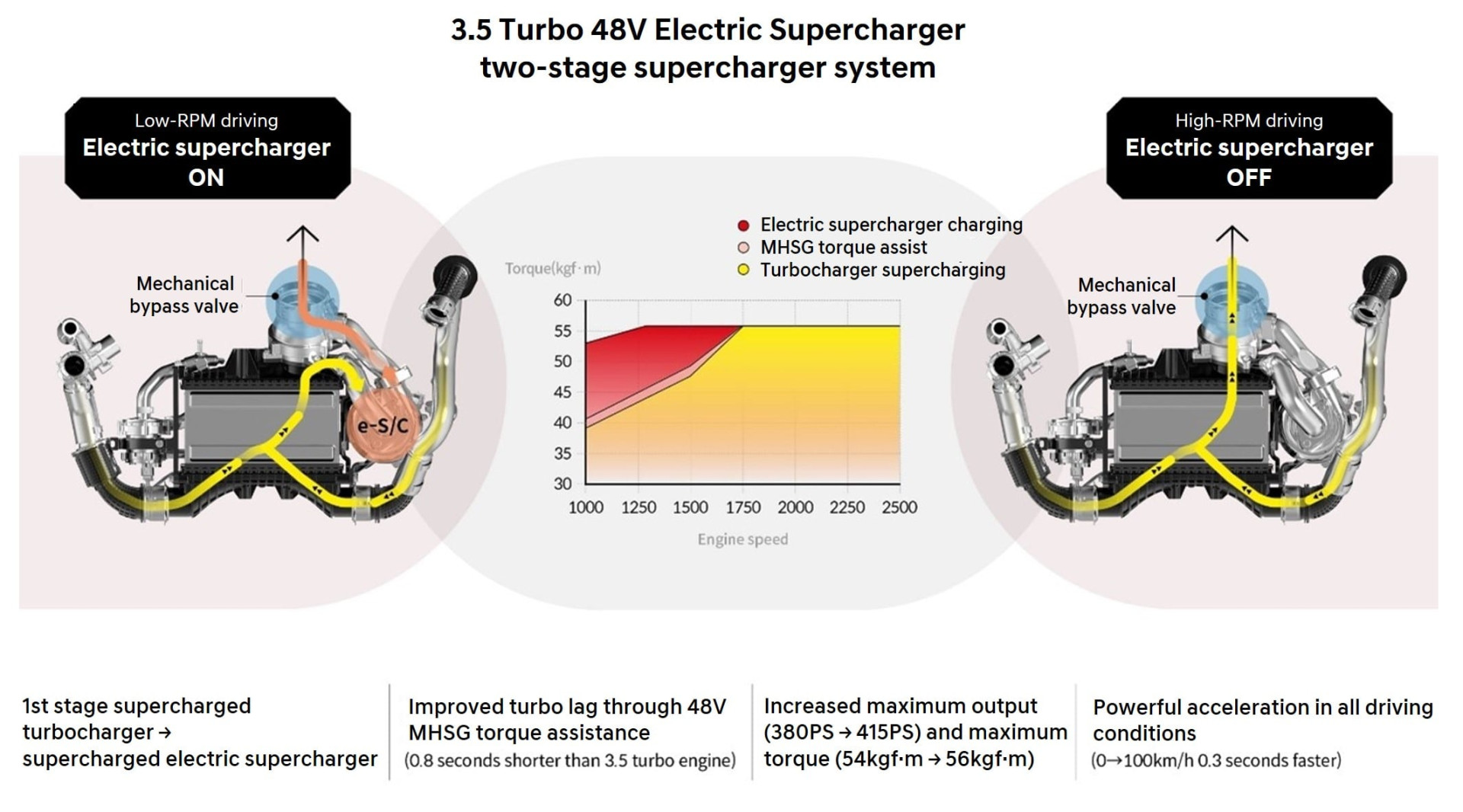
Airflow is controlled by the mechanical bypass valve. It has a spring inside that opens and closes the air path based on a steady difference in air pressure, which prevents sudden fluctuations in air supply to the engine when the e-supercharger is activated.
Unlike a regular 12-volt e-supercharger found in traditional engines, a 48-volt system can deliver a significant amount of air to boost engine output. Another advantage of the 48-volt e-supercharger is that it’s powered by an electric motor, making it more efficient than traditional mechanical superchargers that rely on engine power.
Thrilling Driving Pleasure
The e-supercharger-boosted engine not only increases maximum power and torque compared to the standard twin-turbocharged 3.5-liter V-6, but also alters the way power is delivered. The stark difference is evident when comparing torque and power graphs of both engine types.
While both engines reach peak torque at 1,300 revolutions per minute, the torque graph of the twin-turbocharged 3.5-liter V-6 rises sharply before that, resulting in a subtle fluctuation in output. Whereas with the other type of engine, because the e-supercharger assists the engine at lower revolutions per minute, it reaches peak torque more smoothly, and the torque decline after 4,500 revolutions per minute is more gradual.
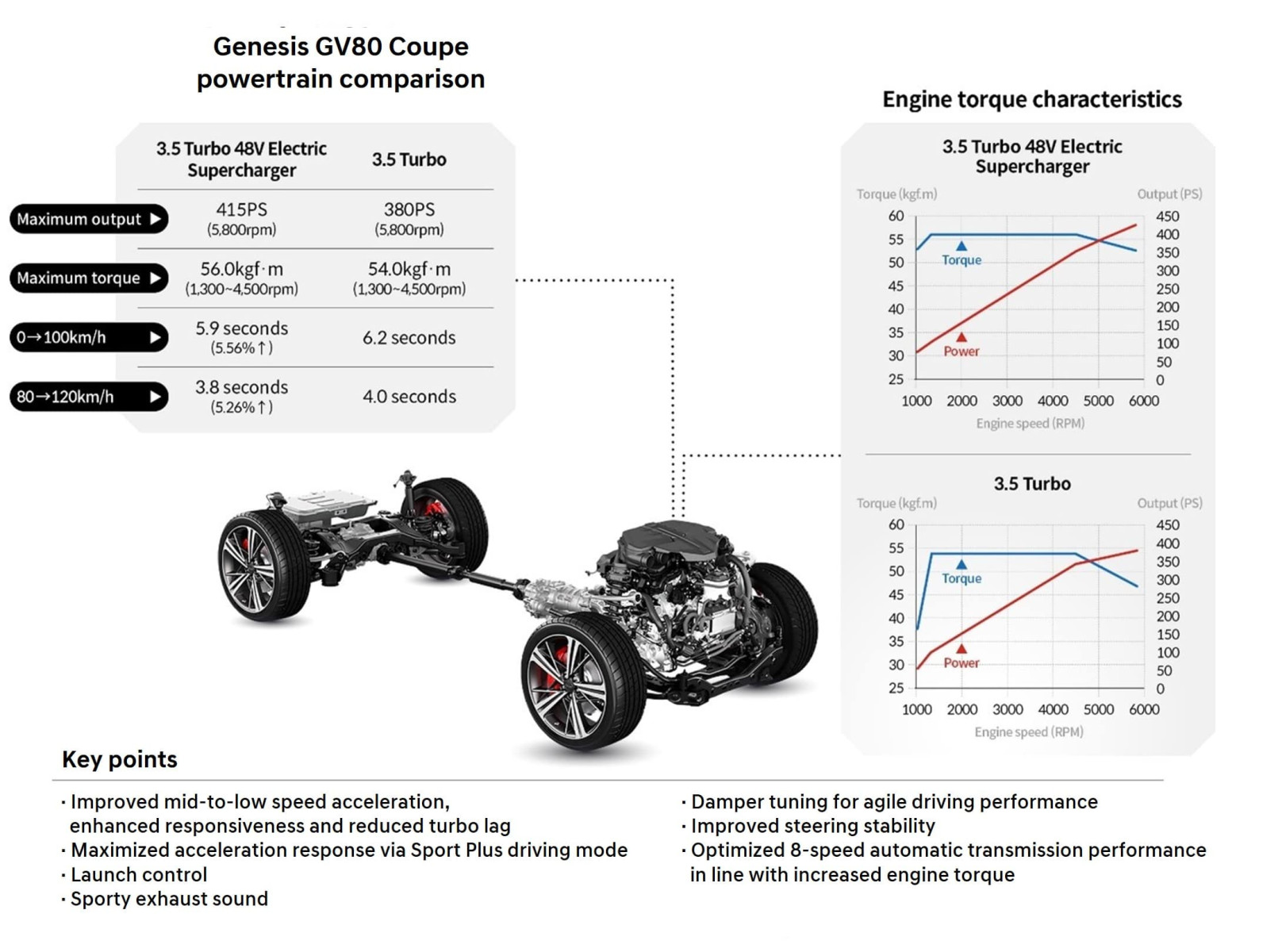
When switching to Sport Plus Mode, the e-supercharger-assisted engine provides a more aggressive control over the output and torque, giving a strong push feel when shifting up gears and automatically adjusting the revs when downshifting. A newly added launch control feature maximizes acceleration from a standstill.
To complement the improved engine performance, the running performance has also been refined. The damper tuning that supports the vehicle’s chassis has been modified to reduce rolling and pitching movements, allowing for better control of the vehicle. The steering system has been fine-tuned as well to enhance steering stability. The enhanced exhaust sounds add an extra level of excitement to the overall driving sensation.
Improved Fuel Efficiency
The GV80 Coupe’s e-supercharger-equipped engine also offers improved fuel efficiency and reduced carbon emissions, chiefly thanks to the MHSG. The MHSG performs the role of a starter motor, turning the engine crankshaft as soon as the engine is started. With higher output than a conventional starter motor, it provides excellent startability. Its connection to the engine via a belt further allows for effective reduction of vibrations and noise.
During steady driving, the MHSG uses power from the 48-volt lithium battery to supply the needed energy to the drivetrain system. During deceleration, the MHSG performs regenerative braking, collecting energy back into the 48-volt battery.
During inertial driving, when the accelerator pedal is not pressed and the vehicle is coming to a stop, the MHSG system engages the Extended Idle Stop & Go (ISG) function, which cuts off fuel injection to the engine — a stark contrast to the conventional ISG, which only operates when the vehicle is completely stopped.
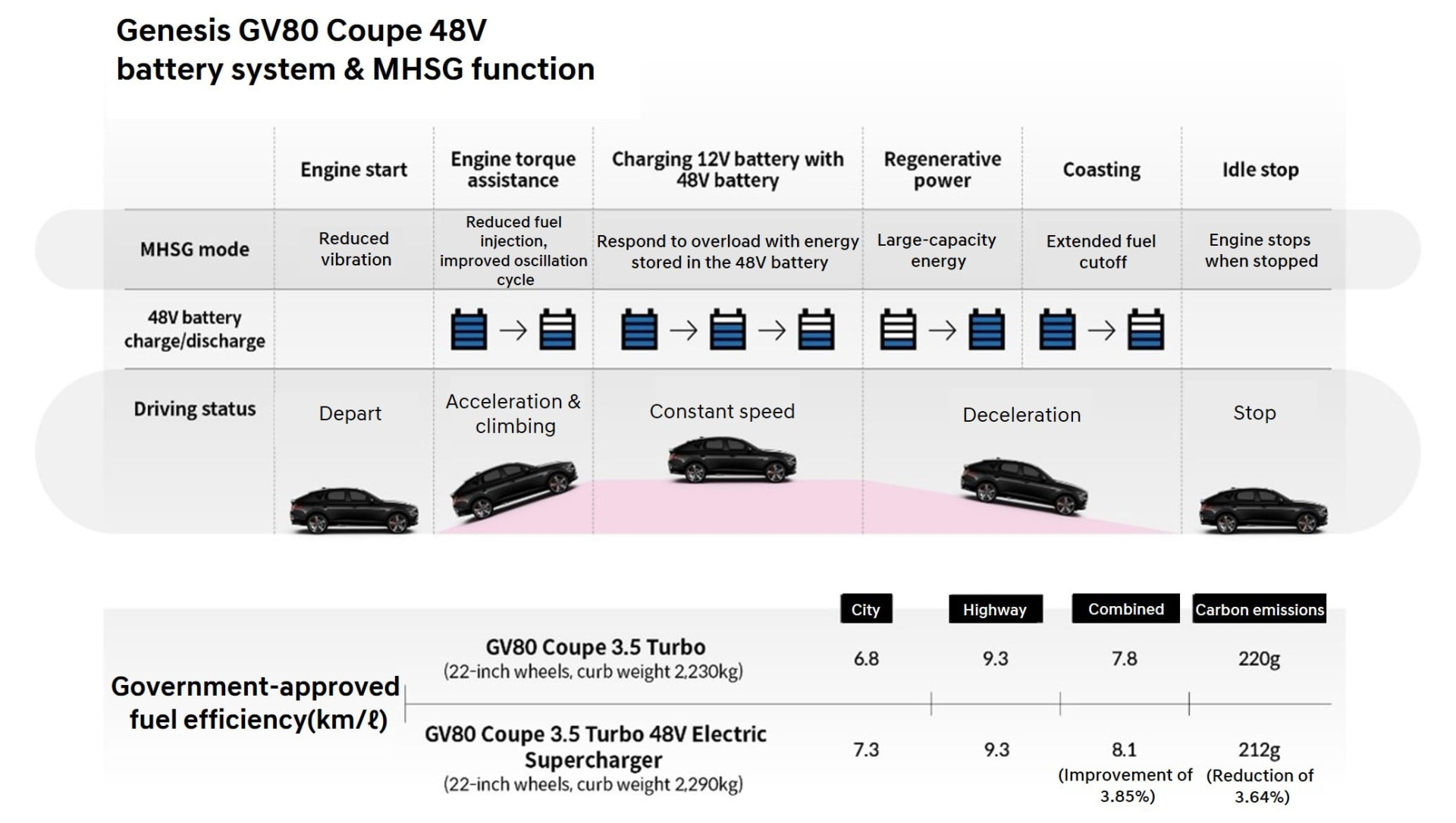
Compared to the turbocharged 3.5-liter V-6, the e-supercharger-boosted engine matched with 22-inch wheels offers a 3.85-percent improvement in fuel efficiency (0.3 kilometers per liter) and a 3.64-percent reduction in carbon emissions (8 grams).
Disclaimer: Specifications may vary depending on region. Please contact your local Genesis retailer for more information.