

GV90 DEEP DIVE PART 3: A NEW STANDARD OF POISE AND SERENITY
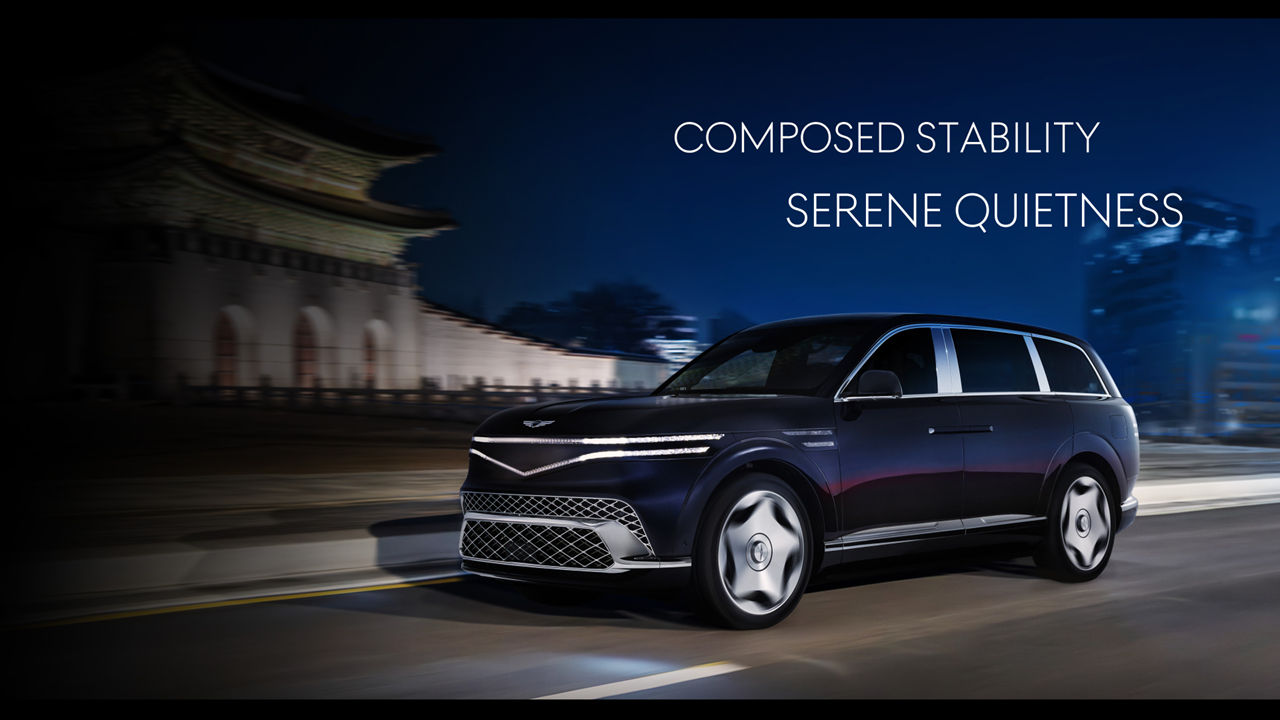
SEOUL, Oct. 20, 2026 — For a luxury flagship, true sophistication is measured not just by acceleration or top speed, but by how composed and effortless a vehicle feels across every road surface. Delivering this balance, however, is one of automotive engineering’s most persistent challenges — a suspension tuned for sharp handling and body control can often compromise ride comfort, while a softer setup risks float and instability at higher speeds.
For the Genesis GV90, resolving that trade-off was the primary focus of Sungki Jung and his team at Genesis Vehicle Testing Group 1. Their approach centers on two clear development priorities: maintaining stable, controlled vehicle behavior in all driving conditions, and creating a cabin environment insulated from external noise and vibration.
“We believe moments of refinement are created through elegant, quiet movement,” Jung explains.
“Flagship-level driving performance requires both dynamic driving and comfort, which are qualities that are difficult to deliver simultaneously. Our development direction came down to two priorities: stable, composed behavior that remains firmly controlled in every driving situation, and quietness that makes the cabin feel calm and isolated from the world outside.”
Precision Down to the Millimeter
“Outstanding driving performance is determined in places you cannot see, and it begins with suspension geometry,” says Jung. “We refined this geometry down to the millimeter to find the ideal balance for a flagship vehicle.”
Suspension geometry refers to the exact angles, pickup points, and spatial arrangements that govern how the tires contact the road and how impact forces are transmitted through the vehicle’s body.
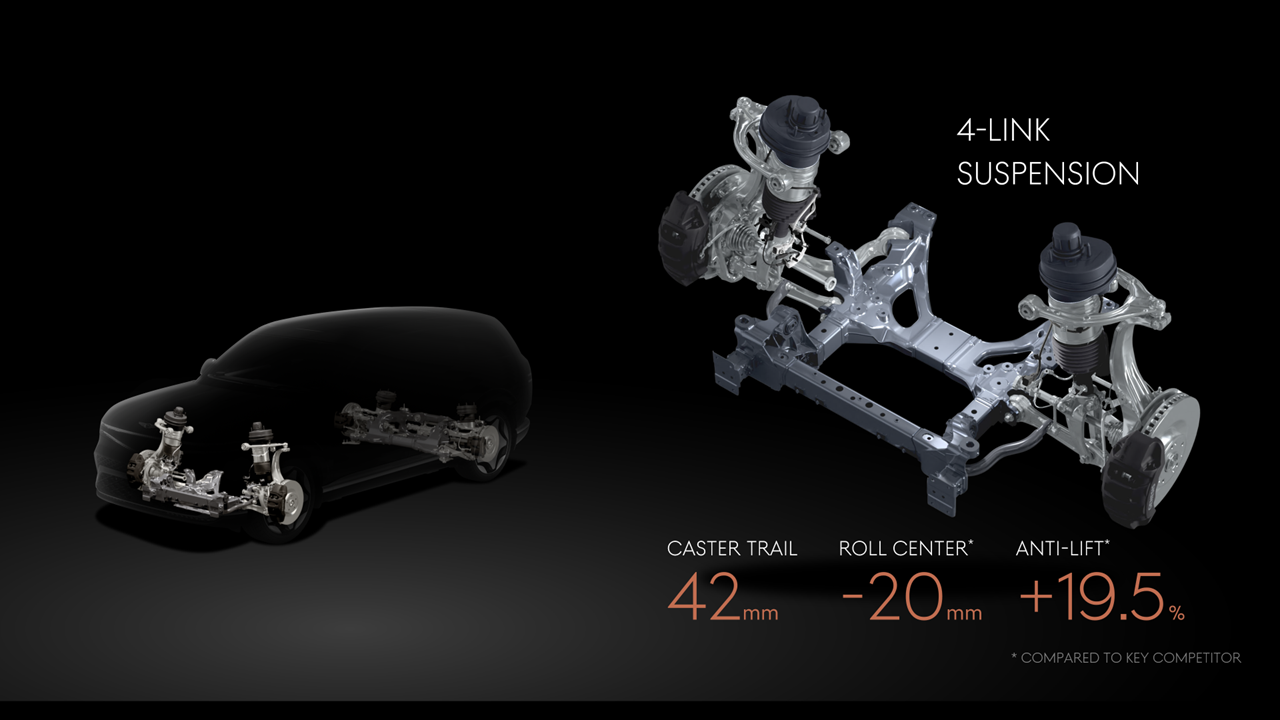
On the front suspension, the team achieved a generous 42 millimeters of caster trail. This setup strengthens the steering system’s natural self-centering characteristics, giving the steering wheel a more substantial, reassuring feel and reinforcing the driver’s connection to the road.
To counteract the “jacking” effect — a tendency for an SUV’s body to lift during cornering — the roll center was lowered by 20 millimeters compared to key competitor benchmarks. Combined with enhanced anti-lift characteristics that suppress front-end rise under hard acceleration, the front geometry helps keep all four wheels planted and the body level.
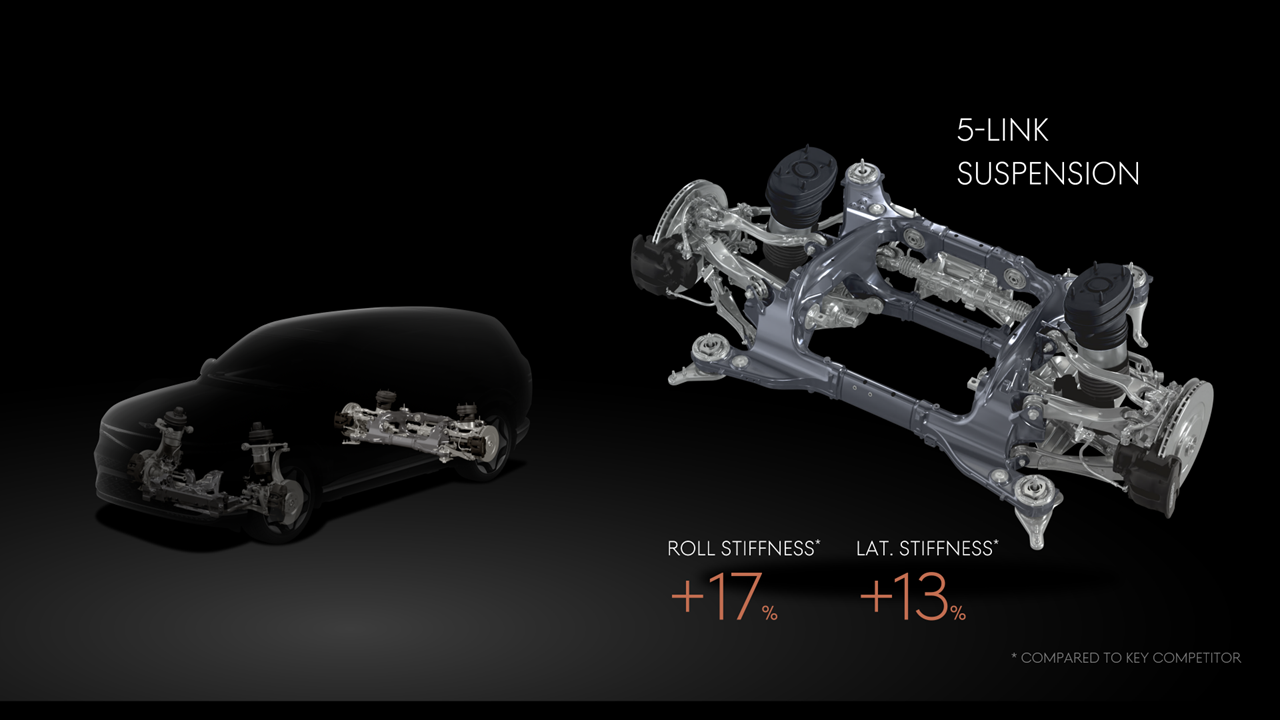
At the rear, the focus was placed squarely on stability and ride refinement. Genesis integrated hydro bushings into the rear crossmember, securing it tightly while absorbing road-induced vibrations. Engineers also stiffened the stabilizer bar, increasing roll stiffness by 17% and lateral stiffness by 13% over competitors. When the driver selects Sport mode, roll stiffness increases by an additional 15%, ensuring stability and unwavering confidence even during high-speed maneuvers.
An Adaptive Ride
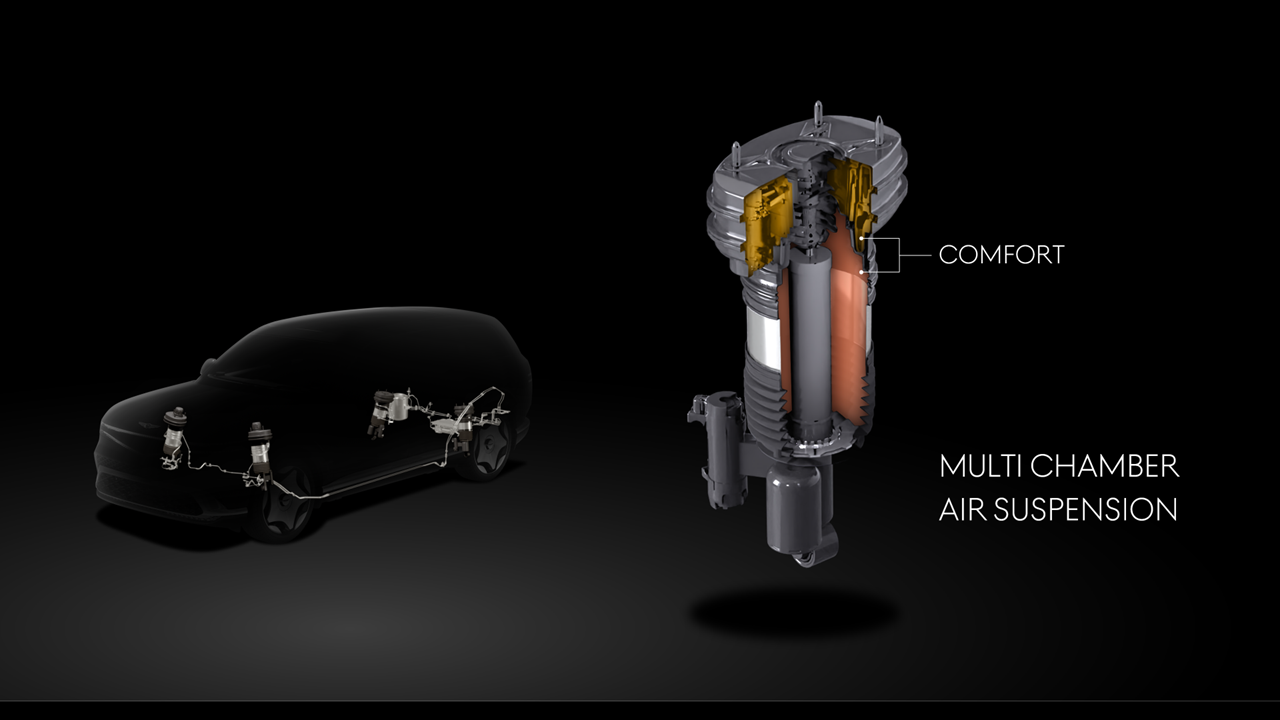
Complementing the suspension geometry is the GV90’s multi-chamber air suspension which comes standard on all model variants. It actively monitors driving conditions and surface inputs to adjust spring rates on the fly.
By opening and closing two internal air chambers at each wheel, the system tailors its firmness to the immediate driving scenario:
Soft Setting: In everyday driving, both chambers remain open to yield a softer air spring that absorbs road imperfections and bumps.
Firm Setting: During high-speed cruising or dynamic cornering, one chamber closes, increasing spring stiffness to suppress body roll and keep the chassis composed.
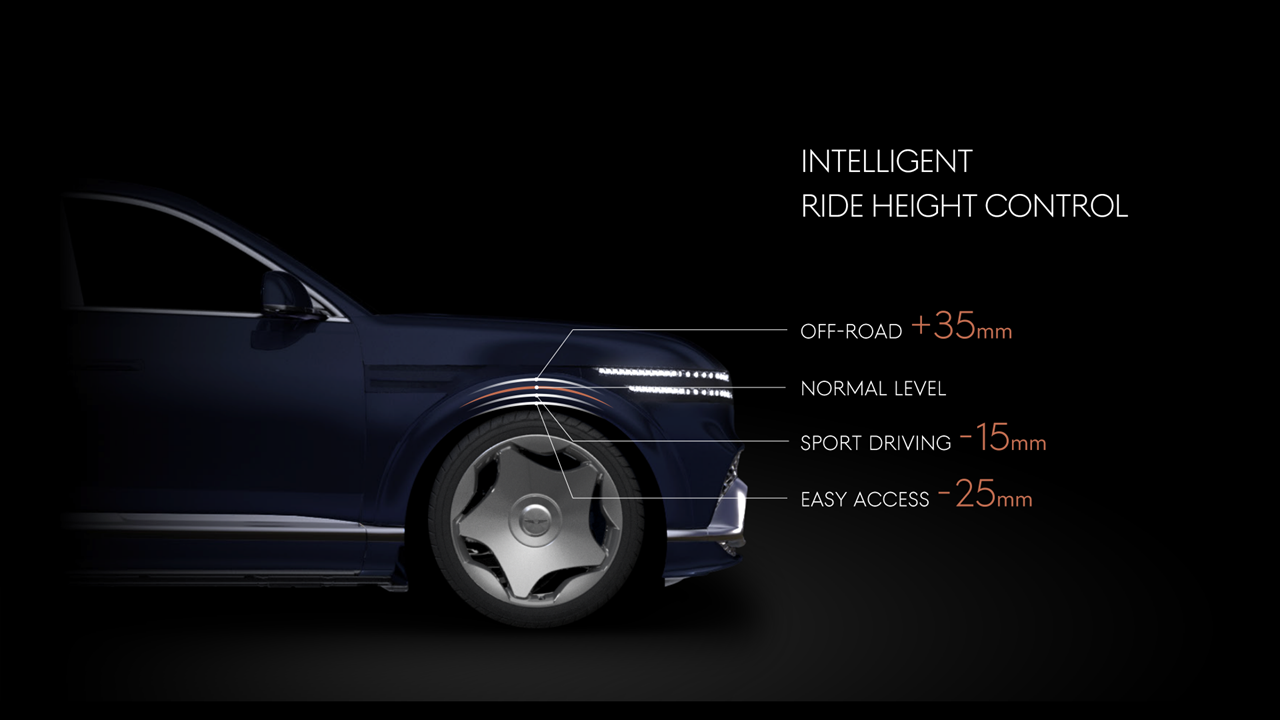
The air suspension also manages vehicle ride height automatically. It raises the chassis by 35 millimeters on rough surfaces to prevent underbody damage and lowers it by 15 millimeters in Sport mode to enhance aerodynamic efficiency and stability. For everyday convenience, the system lowers the vehicle by 25 millimeters for easier entry and exit, while the rear can be lowered by up to 40 millimeters to simplify cargo loading.
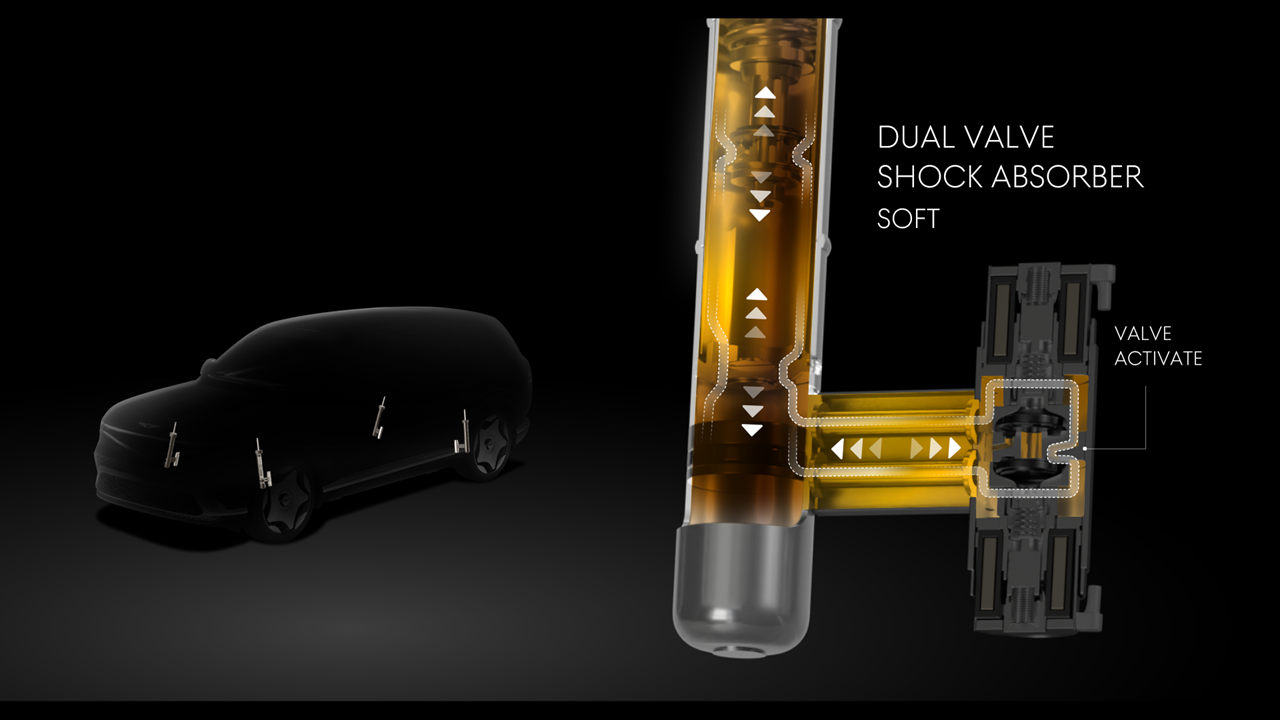
Working alongside the air springs are monotube dual-valve electronically controlled shock absorbers (ECS). Traditional dampers must balance compression (absorbing road bumps) and rebound (controlling the return motion) through shared pathways. The GV90 separates these functions into independent valves, adjusting damping forces continuously rather than cycling between a few fixed presets. As road impacts occur, the shock absorbers manage them smoothly and quickly stabilize body motion, producing a fluid, level ride.
Traction and Agility
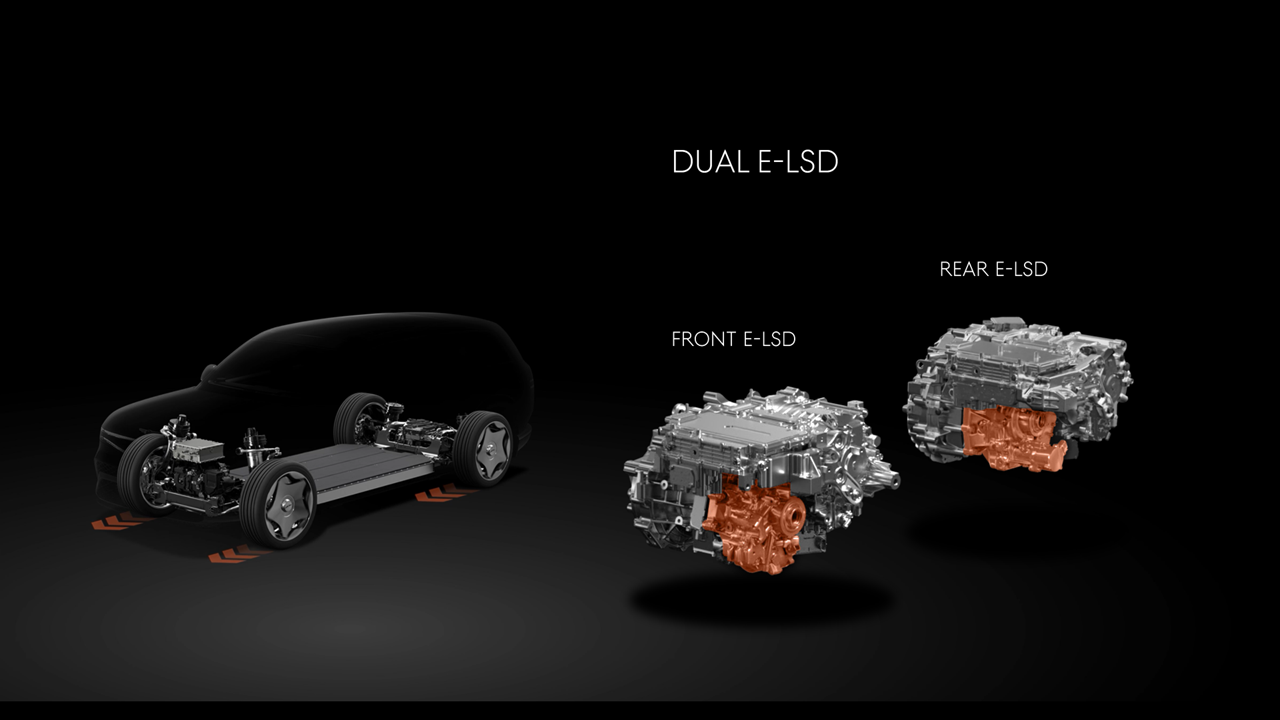
Electronic limited-slip differentials (e-LSDs) are typically reserved for dedicated sports cars, but Genesis chose to integrate e-LSDs into both the front and rear Power Electric (PE) systems — a first for Hyundai Motor Group.
“Limited-slip differentials, such as an e-LSD, are often seen as technologies reserved for sports cars or high-performance vehicles, but we saw it differently,” Jung emphasizes. “We believed that a Genesis flagship should deliver stable, effortless driving in any road condition and situation.”
Utilizing fast-acting Brushless Alternating Current (BLAC) motor actuators, the dual e-LSDs continuously distribute torque across all four wheels based on real-time driving inputs:
Cornering: Power is actively metered between the inside and outside wheels, improving traction, curbing understeer, and helping the vehicle remain agile through turns.
Low-Grip Surfaces: On snow, wet asphalt, or unpaved roads, torque is quickly diverted away from slipping wheels to those with available grip, maintaining steady traction and vehicle control.
A Comprehensive Approach to NVH
Electric vehicles introduce unique acoustic demands. Without the background hum of an internal combustion engine, ambient wind noise, road roar, and electric powertrain sounds become significantly amplified and are more noticeable to occupants.
“Beyond driving well, the GV90 refines every moment inside to be exceptionally quiet,” Jung states. “And it begins with the windows, the first barrier against outside noise.”
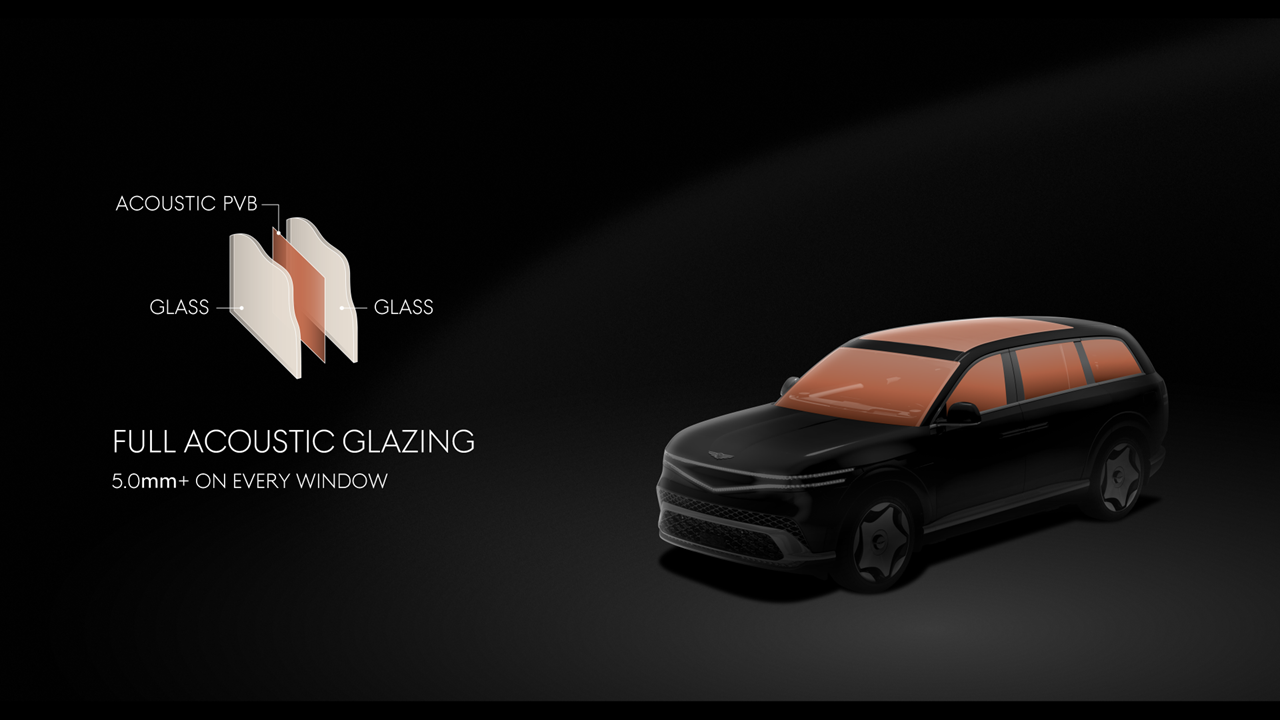
Genesis addressed this by insulating the cabin at every key noise path, starting with the glass. For the first time on a Genesis model, acoustic glass measuring 5.0 millimeters or thicker is applied to every window of the GV90 — some of the thickest among vehicles in its class.
The side windows and the expansive Smart Vision Roof feature even thicker 5.7-millimeter acoustic glass, which incorporates a dedicated sound-absorbing film sandwiched between two layers of glass to filter wind and road noise. Across the cabin, the same glazing reduces interior noise levels by three decibels compared to previous Genesis models.
Behind the exterior panels, dense insulation pads line every critical acoustic transmission pathway, including the dashboard partition separating the front motor compartment from the cabin, the floor pans, the wheel arches and the luggage area. Genesis also modified its assembly processes to fit sound-absorbing materials around underfloor wiring runs, preventing sound from traveling through these passages.
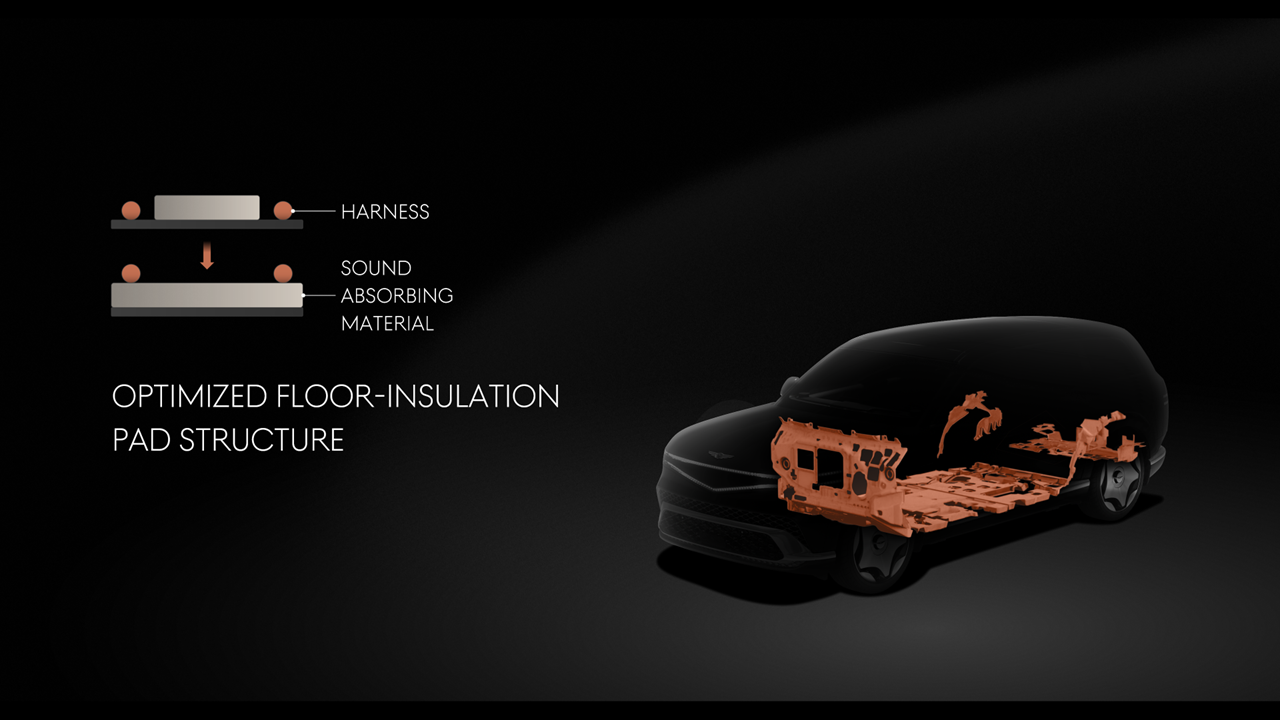
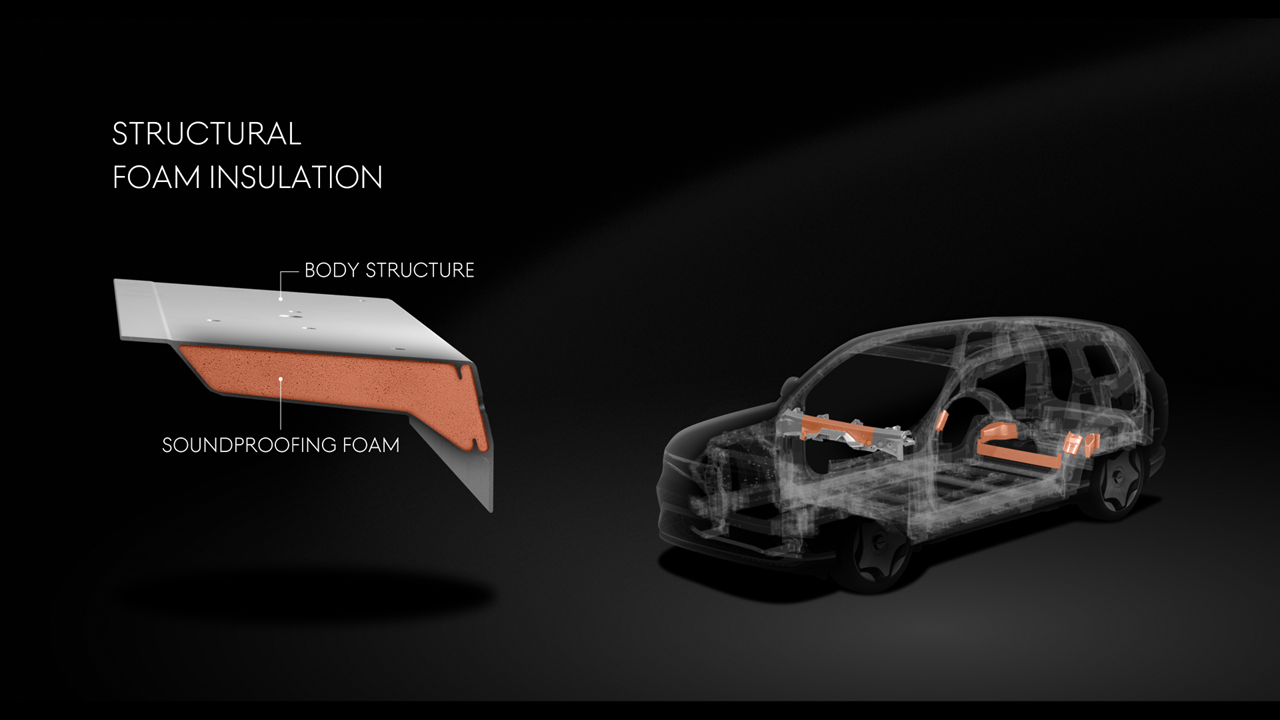
Additionally, engineers applied high-expansion acoustic foam inside the vehicle’s hollow body frame sections across six key locations. Injected during manufacturing, the foam expands up to 45 times its initial volume, sealing internal air channels and stiffening localized structural points to dampen vibrations. In standardized vehicle testing, this reduced mid- and high-frequency cabin noise by up to three decibels.
Cargo Partitioning
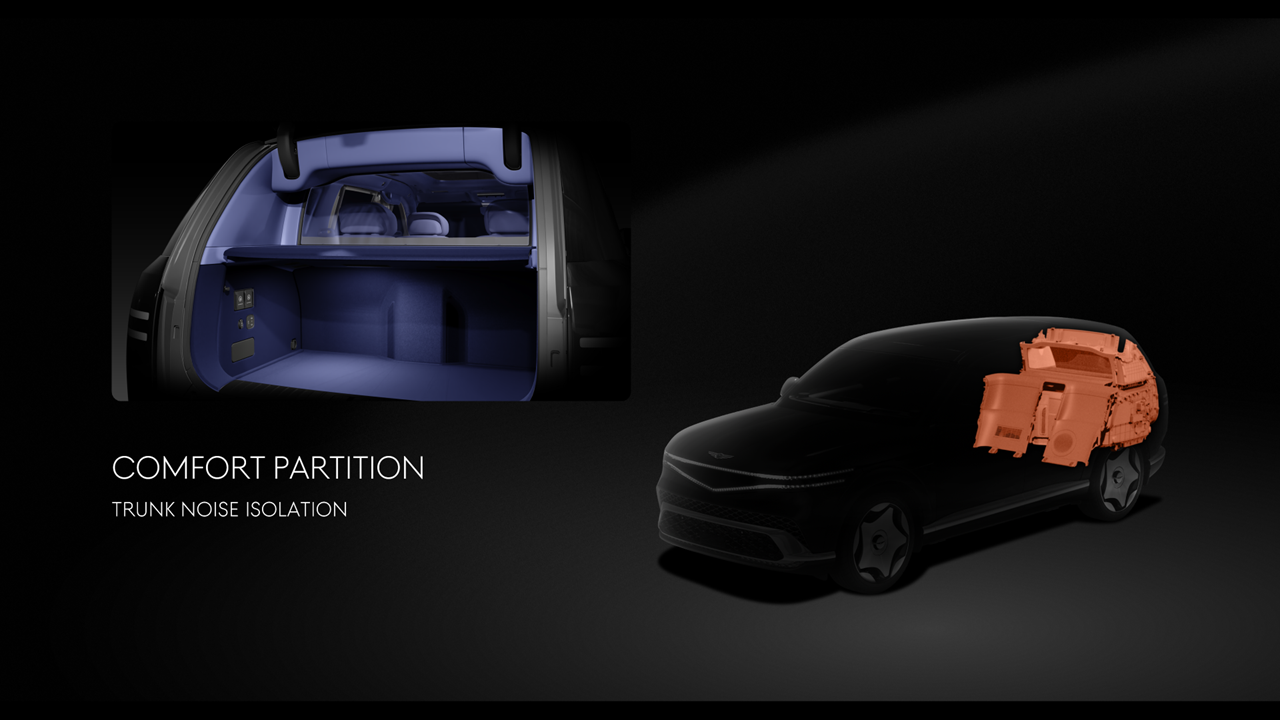
In conventional SUV layouts, the open cargo area can channel road and tire noise from the rear wheels forward into the passenger compartment.
To address this in the GV90 Neolun Executive Suite (4-seat configuration), Genesis introduced a dedicated Comfort Partition positioned directly behind the second-row seats. By physically separating the passenger space from the trunk, the partition blocks cargo-area resonance, providing second-row occupants with an acoustic environment comparable to a luxury sedan.
Managing Powertrain Noise at the Source
Electric drive motors generate torque through electrical current, and subtle fluctuations in current flow can produce distinct high-frequency noise and micro-vibrations.
Rather than relying purely on passive sound deadening, Genesis engineers tackled this at the control stage itself. The motor control unit introduces an opposing electrical waveform to neutralize current fluctuations directly, canceling out motor whine at the source.
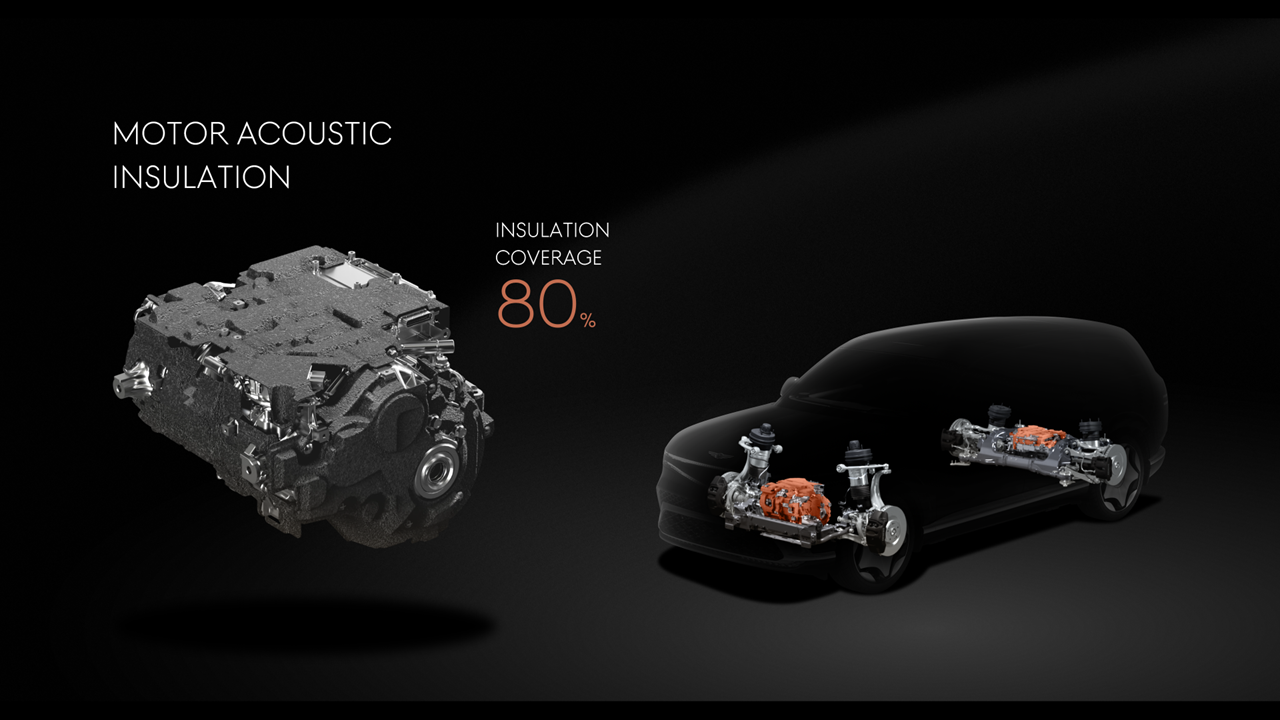
For any residual sound, the coverage of sound-absorbing and insulating materials wrapped around the electric motors and control units increased to 80%, keeping the powertrain quiet even during heavy acceleration.
A Masterclass in Balanced Refinement
The Genesis GV90’s ride and handling, as well as noise, vibration and harshness (NVH) engineering reflect a balanced, disciplined approach to vehicle dynamics.
By pairing responsive, predictable handling with comprehensive cabin isolation, the GV90 delivers on that vision, providing a composed, quiet driving experience across every mile.
“Stable driving confidence and exceptional quietness — only when these two qualities coexist is every moment of travel elevated with refinement,” Jung concludes.