

INSIDE THE REDESIGNED GENESIS GV70: RIDE AND HANDLING
SEOUL, Aug. 13, 2024 — After nearly four years on the road, Genesis has released a redesigned GV70 with added luxury details and convenience features, aiming to provide a more relaxed driving experience.
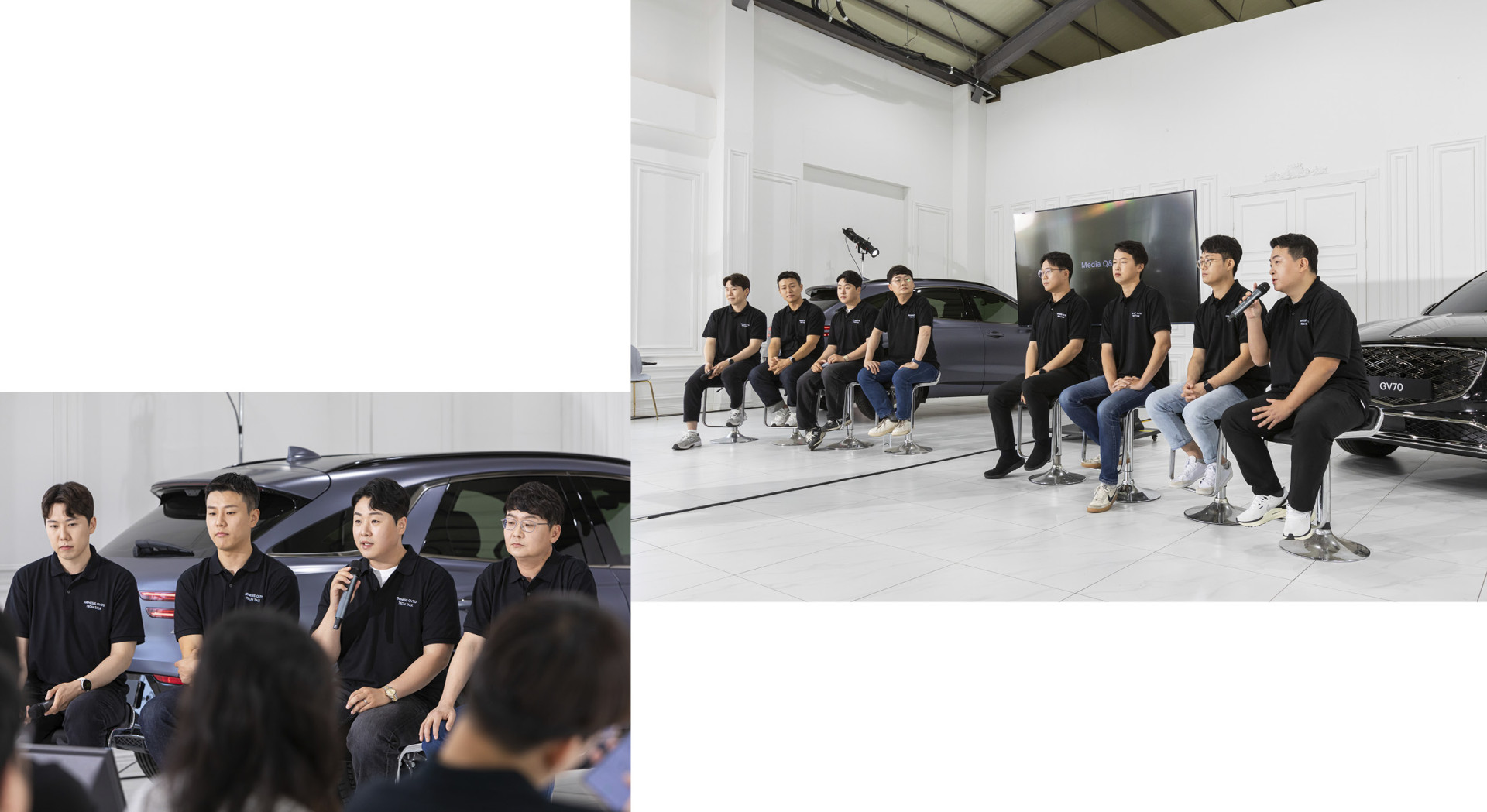
Research engineers from the Namyang R&D Center gathered with local media last June, a month after the new model was launched in Korea, to introduce the host of enhancements. In a two-part series, the Genesis Newsroom shares key highlights from the event, starting with improvements on ride and handling.

Hydro Bushings
The newly designed GV70 boasts new hydro bushings that effectively reduce road vibrations, resulting in a significantly smoother and more peaceful driving experience. Unlike conventional bushings that rely solely on the elasticity of rubber to absorb shocks, hydro bushings in the redesigned GV70 utilize the flow of fluid through an orifice (an opening or hole) within the cylindrical components.
“The latest GV70 comes with hydro bushings on the front tension arm and rear crossmember,” Jinhyeock Yoon, Senior Research Engineer at the Genesis R&H Test Team, explained during the session. As a result of these bushings, Yoon continued, vibrations experienced during rough road driving are reduced by about 40 percent for passengers in the rear seats, with residual vibrations felt after passing speed bumps are also significantly lessened.

Preview-ESC
Other features in the redesigned GV70 that contribute to a stabler driving experience are a variable gear ratio steering system as well as refined springs and stabilizer bars constituting the suspension system. The suspension’s front and rear spring stiffness have been re-adjusted to reduce pitch (vertical movement of the vehicle) during driving, while the center of bounce has been moved 15 percent further back for a more natural movement of the vehicle body.
When driving across speed bumps or potholes, the model’s Preview Electronically-Controlled Suspension (Preview-ECS) system particularly comes in handy, noted Hyungjin Kim, Senior Research Engineer at the Vehicle Motion Control Development Team. The advanced feature utilizes data from a front camera and navigation map to predict oncoming road conditions, using the information to adjust the suspension system and ensure optimal ride comfort.

HBC
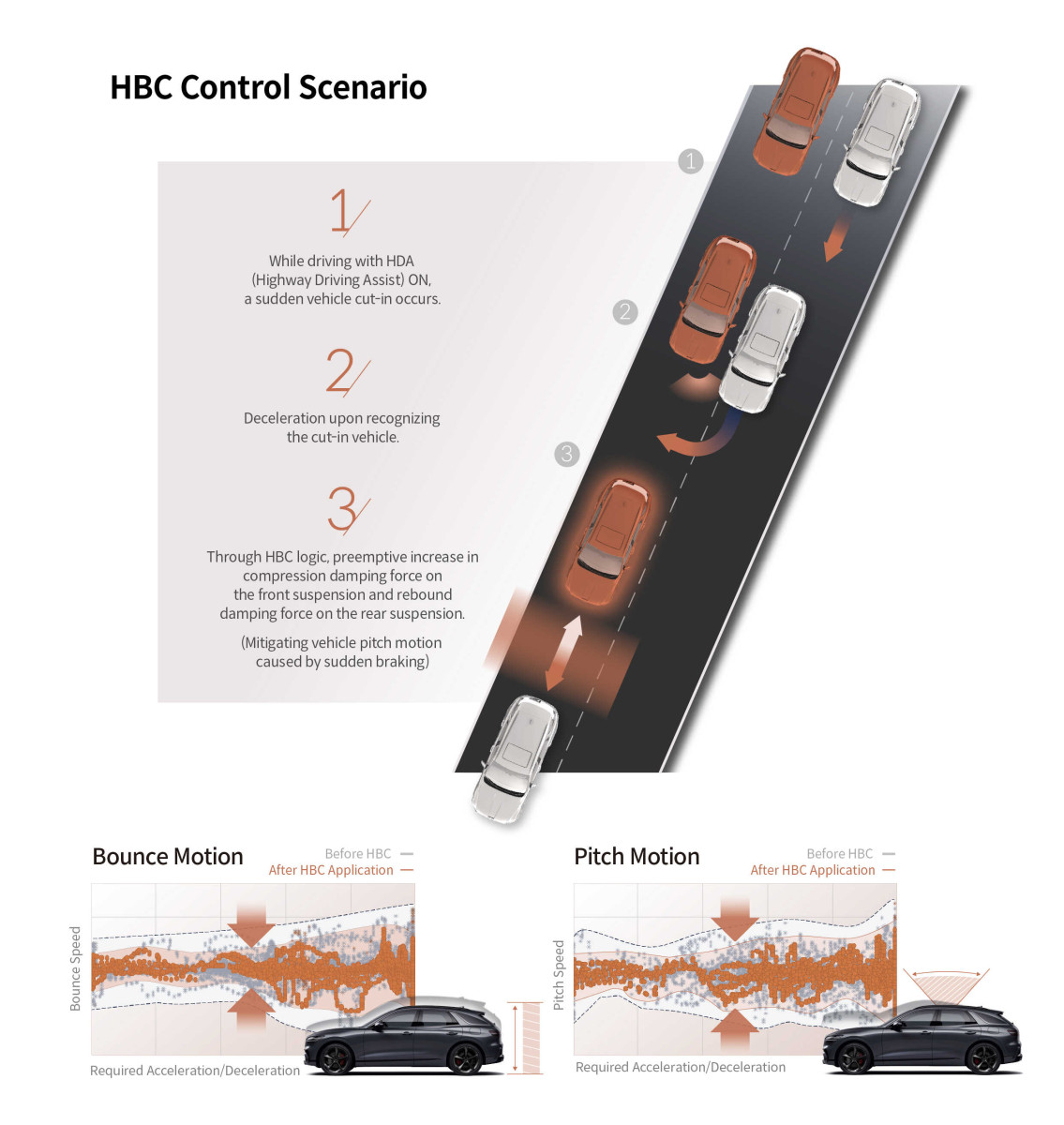
When Highway Driving Assist (HDA) is engaged on highways, the redesigned GV70 benefits from the newly implemented Highway Body Motion Control (HBC) technology. The innovative feature effectively minimizes the jolts caused by sudden acceleration or braking, enhancing the stability of the vehicle’s body movement. With HBC in action, the GV70 is well-equipped to handle unexpected changes in speed from vehicles ahead, ensuring a smoother and safer driving experience on highways.
“When the HDA-equipped GV70 suddenly brakes to maintain distance from the cutting-in vehicle, Preview-ECS kicks in and controls the damping force on the front and rear wheels, reducing vertical movement and pitch motion,” Kim explained.
Auto Terrain Mode
Unlike its predecessor, which featured a Terrain Mode that allowed drivers to manually select their preferred driving mode, the redesigned GV70 comes with an Auto Terrain Mode, which incorporates artificial intelligence in autonomously selecting the most appropriate driving mode based on various factors such as engine revolutions per minute (RPM), longitudinal acceleration and other real-time data. Using the input, the vehicle distinguishes between normal roads, snow, mud and sand, optimizing all-wheel drive, Electronic Stability Control (ESC) and Electronic Limited Slip Differential (e-LSD) accordingly.
Integrated into this Auto Terrain Mode is the Downhill Brake Control (DBC) logic, which utilizes an accelerometer to evaluate the slope of the road while driving. If the system determines that the road surface on a downhill section is muddy, the driving mode is automatically switched to “Mud.” Even if the road surface transitions back to normal, the driving mode is maintained for safety purposes. If the road slope changes by approximately five percent in a flatter direction, the vehicle is switched back to normal driving mode.

“The Auto Terrain Mode has a 99 percent accuracy rate for recognizing road conditions,” said Kyoungsoo We, Senior Research Engineer at the Vehicle Control Technology Development Team. “The new GV70 can also distinguish between cobblestone and gravel roads.”
Crosswind Stability Control
When crosswinds strike, nothing comes handier than Crosswind Stability Control, said Minje Hyun, Senior Research Engineer at the Vehicle Motion Control Development Team.
Crosswind Stability Control combines the functions of individual wheel braking, controlled by the ESC, and the Electric Power Steering (EPS) system. Gyro sensors, accelerometers and wheel speed sensors detect the vehicle’s movements, assess the need for steering correction and individual wheel braking based on the level of crosswind, and then control the appropriate level of steering and braking based on the driver’s response.
The Crosswind Stability Control function activates when the vehicle’s speed exceeds 70 kilometers per hour and detects lateral forces up to 0.3 times the acceleration due to gravity (0.3g) during straight-line driving. In the event of winds exceeding 10 meters per second, indicating a storm warning, the system automatically adjusts the vehicle’s body to maintain stability.
“Crosswind Stability Control helps prevent the car from wobbling during sudden crosswinds,” said Hyun. “To further improve this technology, we are exploring the possibility of incorporating features that will alert following vehicles about the presence of crosswinds or integrating the system with Preview-ECS to enhance overall ride comfort.”
Disclaimer: Specifications may vary depending on region. Please contact your local Genesis retailer for more information.