

NANO COOLING FILM TO LOWER CABIN TEMPS IN HOT WEATHER
SEOUL, Aug. 6, 2024 — Summer brings fun times, long road trips — and sweltering car cabins. That’s about to change with a new technology developed by the Hyundai Motor Group (the Group), dubbed Nano Cooling Film.
The technology was introduced at the 2024 Cannes Lions International Festival of Creativity in France last June, as the Group was invited to talk about innovative technologies transforming the world. It was the first time that a car manufacturer presented at the seminar, which traditionally delves into marketing insights and solutions.
Minjae Lee, a Senior Research Engineer at the Group’s Energy Devices Research Team, took the stage and explained how the Group’s Nano Cooling Film effectively lowers cabin temperatures by more than 10 degrees Celsius without window tinting. This not only creates a more comfortable environment for passengers but also significantly reduces the energy consumption needed to cool the interior, lowering energy costs in a sustainable manner.

Unlike conventional tinting films that block external heat, Nano Cooling Film also allows internal heat to escape, thanks to a unique composition of three layers. The film’s outer layer radiates heat at mid-infrared wavelengths from the interior of the vehicle to the exterior, while the inner two layers reflect incoming heat at near-infrared wavelengths, reducing the total amount of heat that enters the vehicle from the outside.
The film can be applied in tandem with conventional tint films, resulting in even greater cooling effects.
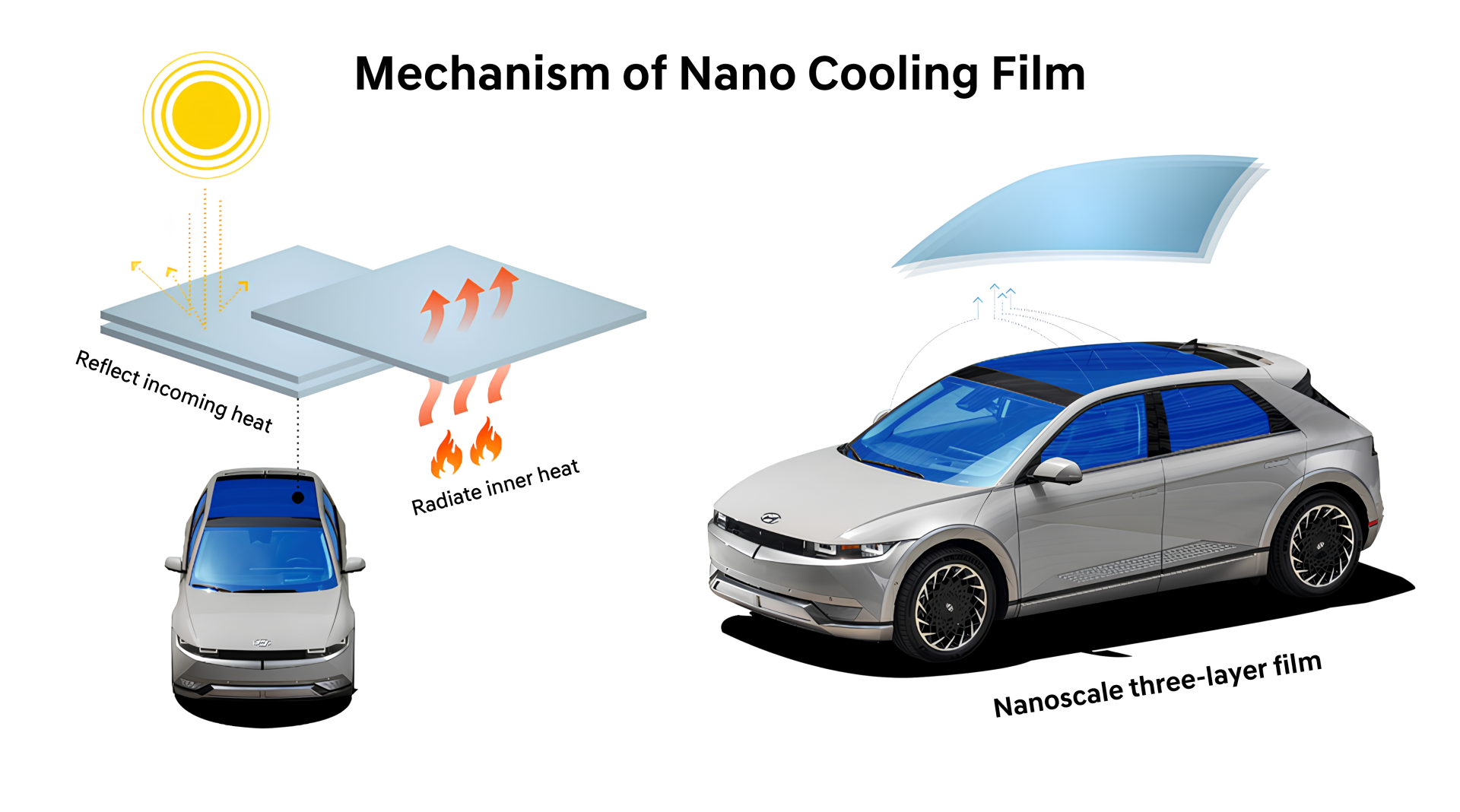
In a recent study, Nano Cooling Film was found to have reduced the temperature near the driver’s head by up to 10.98 degrees Celsius when compared to conventional tint films, and up to 12.33 degrees Celsius when no window tinting was applied. The crash pad temperature of the test vehicle with Nano Cooling Film was 15.38 degrees Celsius lower than with conventional tinting, and 22 degrees Celsius lower than without any tinting at all.
To test its effectiveness is real-life scenarios, the Group applied the film to 70 customer vehicles in Lahore, Pakistan, earlier this year, where window tinting is illegal due to security issues and summer highs can fatally soar above 50 degrees Celsius.
The Group plans to use empirical data from the pilot program to ensure quality and enter mass production in the near future.