

UNLOCKING ADVANCED SUSPENSION WITH GENESIS ‘PREVIEW ECS’
SEOUL, Oct. 24, 2024 — When the GV80 first hit the market in 2020, it revolutionized Genesis across multiple fronts.
It marked the brand’s inaugural entry into the SUV segment, was the first production model derived from a concept, and became the first in the Hyundai Motor Group (the Group) to feature Electronically Controlled Suspension With Road Preview (Preview ECS).
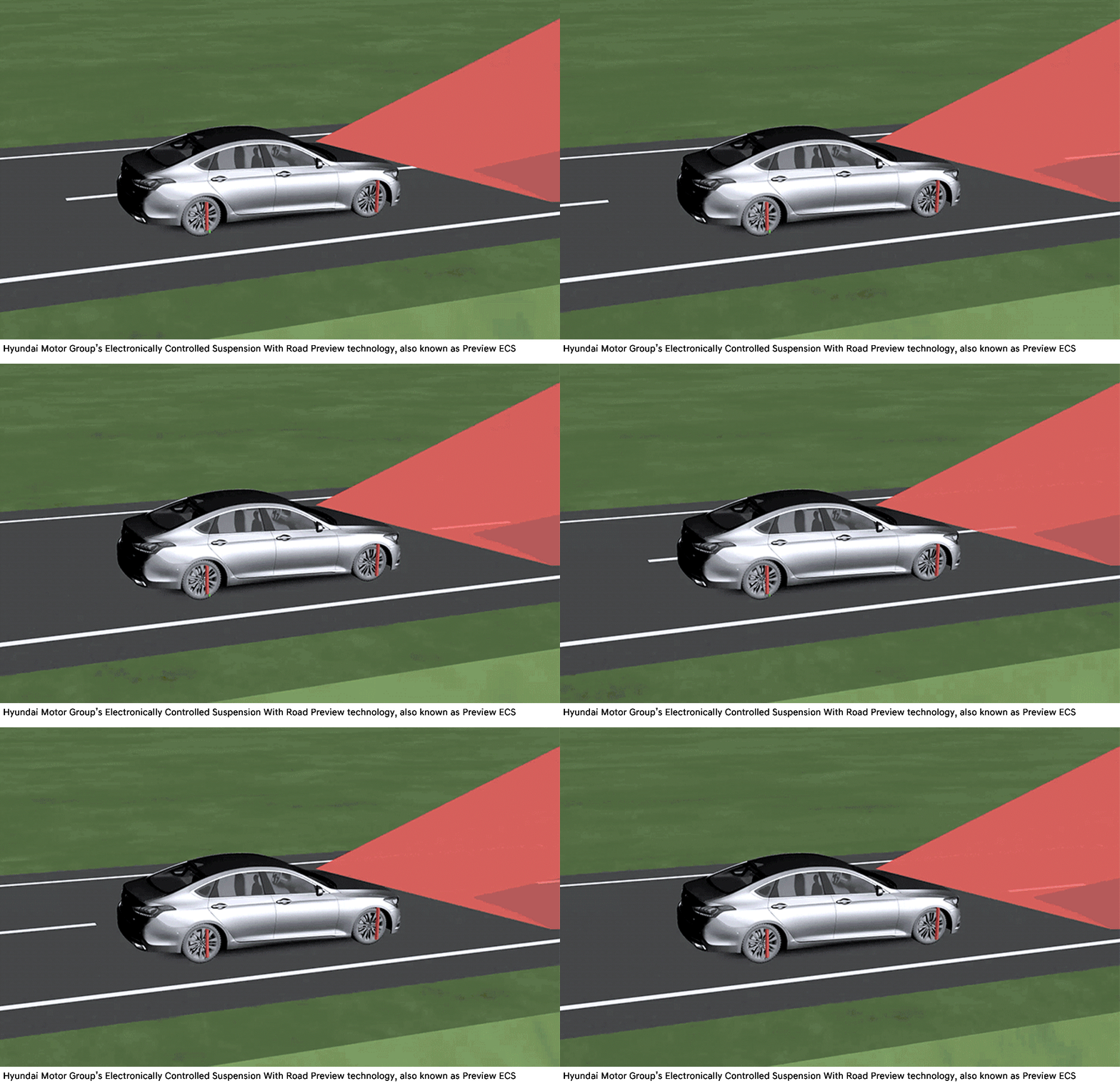
Preview ECS utilizes a forward-facing camera to scan the road ahead for speed bumps or potholes, instantly adjusting front and rear damping to optimize ride comfort and handling control.
Reflecting on the development process of this innovation, four research engineers from the Group’s Vehicle Motion Control Development Team, who played a pivotal role in bringing Preview ECS to life, explain how the technology continues to distinguish itself today.
How did Preview ECS come about?
Jung Inyong: The technology goes back to 2016, when we first started exploring different options for road surface recognition. Light Detection And Ranging (LiDAR) sensors were initially considered, but their high costs rendered them impractical for mass production, which is why we turned our attention to camera systems.
How does Preview ECS in the GV80 compare to similar technology offered by other car manufacturers?
Hyungjin Kim: Unlike competing technologies utilizing a stereo lens camera, the GV80’s Preview ECS employs a single-lens camera, which still performs as good as a stereo lens camera thanks to help from our partner companies and Group colleagues working in autonomous driving development. Competing technologies often face limitations in road surface recognition under certain conditions like nighttime or heavy rain, but Preview ECS uses navigation data, which effectively helps overcome these drawbacks. Another good thing about the GV80’s Preview ECS is that it doesn’t require any additional hardware when compared to the electronically controlled suspension system. Only software dedicated to road surface perception and suspension control need to be added, which enables us to keep manufacturing costs down to a minimum.
How fast can Preview ECS recognize road conditions?
Hyungjin Kim: To accurately perceive road surface conditions, the front-facing camera relies on the vehicle being in motion. In a GV80, the camera is capable of detecting road surface data when the vehicle is traveling at speeds of 10 to 130 kilometers per hour. There could, however, be a slight discrepancy between the speed at which the road surface is recognized and the maximum operational speed of the Preview ECS system.
If the navigation system encounters a GPS error while detecting speed bumps, how does Preview ECS work?
Jung Inyong: In situations where real-time GPS information is found to be inaccurate, Preview ECS will minimize its reliance on this data and revert temporarily to the electronically controlled suspension system without the preview function.

How would you describe the biggest advantage of an electronically controlled suspension?
Wookyun Kim: To control damping, the resistance of the solenoid valve in the GV80 is continuously adjusted every one-thousandth of a second, ensuring ride comfort in any situation. Unlike other suspension systems developed by our competitors, which normally use two solenoid valves that are electronically controlled when compressing and extending, the damper used in the GV80 controls both compression and extension with a single solenoid valve. Having a single solenoid valve reduces overall weight and improves maintenance.
What happens if only one side of the vehicle drives over a speed bump? Can Preview ECS still function effectively in this unorthodox scenario?
Jonghoon Choi: The front-facing camera detects not only the remaining distance between a speed bump but also the height and width of the ridge. Using that data plus the current vehicle speed and steering angle, Preview ECS predicts and computes the trajectories of both wheels. Therefore, even if only one side of the car drives over a speed bump, Preview ECS can still independently control the suspensions mounted on each wheel.
What about rain? With Preview ECS relying on optical cameras, does it also work well in rainy weather?
Hyungjin Kim: It’s true that the optical performance of the front-facing camera can be diminished in low-light conditions such as in nighttime or rain. Its ability to gather information is also limited when the vehicle is too close to the forgoing car. But that’s why Preview ECS was engineered to combine data from the navigation system plus various other sensors — to ensure that the electronically controlled suspension functions optimally under diverse circumstances.

Is there some sort of a data processing device that processes all the information from the road surface?
Byungjoo Kim: Yes, we use an advanced Electronic Control Unit (ECU) that was specifically developed for this unique type of electronically controlled suspension. The ECU works like a high-performance microcomputer. It integrates road surface data gathered from the front camera with inputs from multiple sensors in the vehicle. This extensive range of information is then processed at an incredibly fast rate of 100 calculations per second, allowing the ECU to generate optimal control commands. The electronically controlled suspension operates in conjunction with these commands by continuously adjusting the damping force. These adjustments are made at intervals as small as one-thousandth of a second, ensuring that the suspension system responds to ever-changing road surface conditions.
Can the mechanism behind Preview ECS be adapted for other features?
Wookyun Kim: Several features have already been developed using this mechanism, such as reducing body roll during cornering, and identifying and responding to uneven road surfaces. These additional functionalities weren’t applied to the GV80 considering the model’s overall concept.

What was the biggest challenge in developing Preview ECS, particularly considering that it was its first practical application at the Group?
Hyungjin Kim: Getting lots and lots of data — far beyond what was used in conventional electronically controlled suspensions. We needed data from front-facing cameras and navigation systems, which is why close collaboration between different functions within the Group was crucial. Road recognition technology utilizing a forward-facing camera had never been applied before in our Group, which posed many challenges in the initial development stage of functionality and performance. We conducted endless rounds of testing with our partner companies and internal colleagues. Integrating road surface data from the navigation system into the electronically controlled suspension was also a first for our Group. The whole process required a tremendous amount of time to ensure safety and functionality under various driving conditions.
Disclaimer: Specifications may vary depending on region. Please contact your local Genesis retailer for more information.