

NEW GENESIS-TESTED RADIANT HEATING SYSTEM TO EASE EV RANGE ANXIETY
SEOUL, Feb. 20, 2025 — As electric vehicles (EVs) have become more mainstream, "range anxiety,” or the concern that an EV may not have enough charge to reach its destination, has emerged as a significant worry among potential customers.
To alleviate this concern, Hyundai Motor Group (the Group) is developing an energy-efficient heating system for its EVs, known as the Radiant Heating System (RHS).
First introduced in 2019 with customizable knee warmers in select Hyundai and Kia models, the RHS technology was most recently featured in the Genesis Neolun Concept, unveiled last year. This innovative system aims to optimize energy usage, thereby extending the vehicle's range and enhancing overall driving comfort.

Conduction, Convection and Radiation
Heat transfer can be broadly categorized into three mechanisms: conduction, convection and radiation.
- Conduction occurs when fast-moving molecules collide with slower-moving molecules within a substance, transferring energy and causing the slower molecules to move faster. This phenomenon is primarily observed in metals with high thermal conductivity. In automobiles, conduction is utilized in heated seat cushions and armrests that make direct contact with the body.
- Convection is the transfer of heat through the movement of gases or liquids, exemplified by the way cabins are heated by warm air blowing from air vents during the winter.
- Radiation, on the other hand, involves the emission of heat in the form of electromagnetic waves from a heat source. This is how the sun’s heat reaches the Earth and how warmth is felt from a distant fireplace.
The Group aims to provide a comprehensive heating solution in its vehicles by incorporating all three heat transfer mechanisms: conduction through heated seats and armrests, convection via positive temperature coefficient heaters, and radiation through radiant warmers.

Inspired by Korean ‘Ondol’
When it comes to radiant warmers, Manju Oh, a Senior Researcher at the Group’s Integrated Thermal Management Research Lab, which developed the RHS, recalls being inspired by the Korean concept of “ondol.” Ondol is a widely used heating method in Korean households that heats the floor through conduction, which then radiates heat into the room and warms the air by convection.
“I was drawn to ondol as I was researching everyday examples of radiant heating,” says Oh. “When applying ondol to EVs, our goal was to reduce overall energy consumption while also considering its impact on human comfort.”
The first-generation RHS, implemented as knee warmers, has so far received positive reviews.
“Conventional air conditioners usually take time to warm passengers," says Sola Chung, a Senior Researcher at the Integrated Thermal Management Research Lab. "The RHS, however, directly transfers heat to the body, accomplishing the same task much more quickly.”
The Group is now ready to take the RHS to the next level, Chung explains.
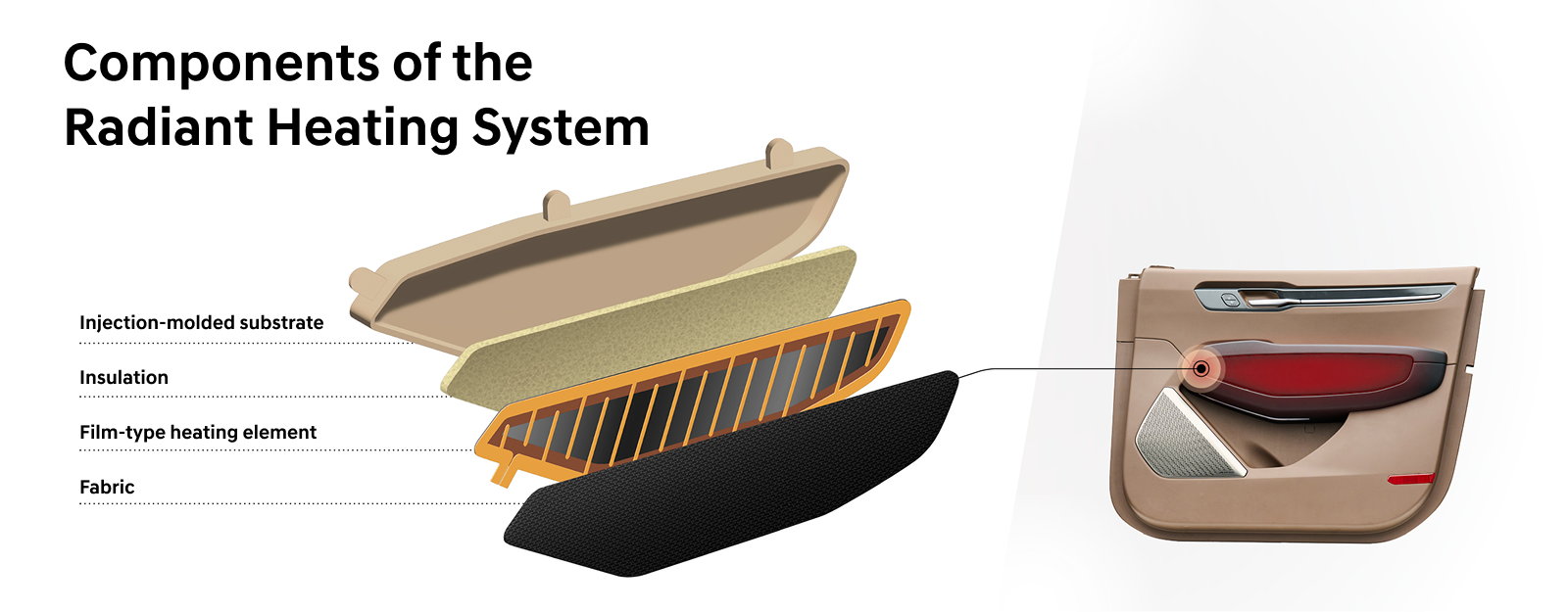
"We developed a test model for the RHS that directs warmth to all areas of the body, allowing us to study the most optimal zones," says Chung. "It employs a film-type heating element made from carbon nanotube material, which provides a larger heating surface compared to the carbon fabric heating element used in the first-generation RHS."
Powered by a newly developed 48-volt power system, preliminary trials of the film in the next-generation RHS demonstrated reductions in energy consumption for heating and improvements in energy efficiency.

The latest RHS addresses the issue of potential burns from two main standpoints: hardware and software.
In terms of hardware, the thickness of the heating element was reduced to lower the heat capacity, and a fabric with low thermal conductivity and heat capacity but high thermal emissivity was utilized in areas of potential skin contact to minimize the risk of burns.
On the software side, a capacitive touch sensor was integrated into the heating element, enabling the immediate shutdown of power control logic upon detecting contact with the body. A safety system also deactivates the heating function immediately in case of component damage, power connection issues or software errors, ensuring thorough prevention of any potential burn risks.
Energy-Efficient Comfort
In discussing the effectiveness of the RHS, researchers often highlight its energy efficiency and user convenience.
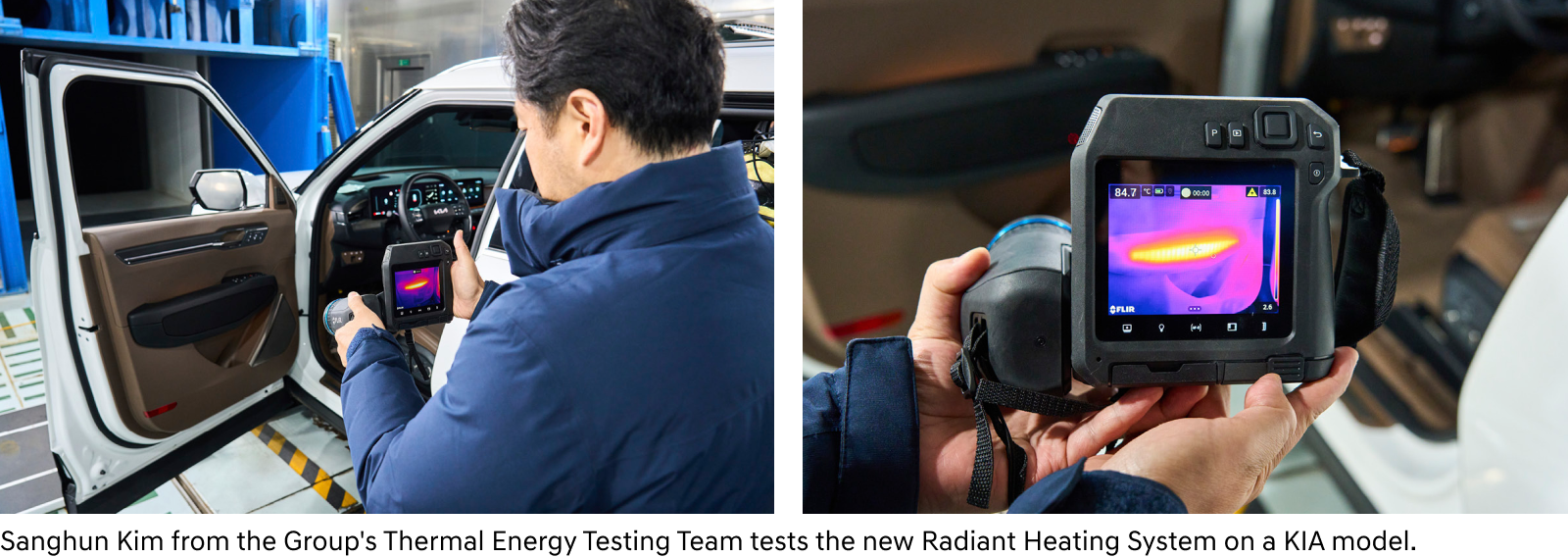
“When traditional convection systems are used in conjunction with the RHS, energy consumption for heating can be reduced by as much as 17 percent,” says Sanghun Kim from the Group’s Thermal Energy Testing Team.
“The system enables passengers to experience the same heating performance with less reliance on traditional heaters, resulting in better humidity levels inside the vehicle,” Chung points out. “This could particularly come as good news to women who avoid using heaters to protect their skin.”
SangYup Lee, Head of Genesis Global Design, said while unveiling the Genesis Neolun Concept last year that it was all about the “new experience.”
“What you feel in the Neolun with ondol is something you won't feel in any other car,” said Lee. “Creating a new experience by evoking all five senses — that's what Genesis is about."